How hard is Lubbock's water, really?
Hard water is measured in grains per gallon (GPG) or parts per million (PPM). The U.S. Geological Survey calls anything above 10.5 GPG (180 PPM) "very hard." Lubbock's municipal supply sits at roughly 13 GPG (220 PPM) for most of the city — some wells run higher — which puts us firmly above the "very hard" cutoff.
Here's why. Lubbock blends three water sources in most years: about 70% comes from the Canadian River Municipal Water Authority (CRMWA), which draws from Lake Meredith and a well field in Roberts County; roughly 18% comes from the city's own Bailey County Well Field (175 wells across Bailey and Lamb Counties); and the rest is local groundwater. The well-field water passes through the Ogallala Aquifer, where it spends centuries filtering through limestone, chalk, and gypsum. That's exactly the geological cocktail that loads water with calcium carbonate and magnesium sulfate — the two minerals responsible for most of the damage you see on your equipment.
The surface water from Lake Meredith is lower-hardness than the well water, but it's blended with the harder groundwater before it hits the mains. Net result: whatever comes out of your sillcock was treated to be safe to drink, not easy on your sprinklers.
What hard water actually does to an irrigation system
Four specific things, in roughly the order you'll see them fail:
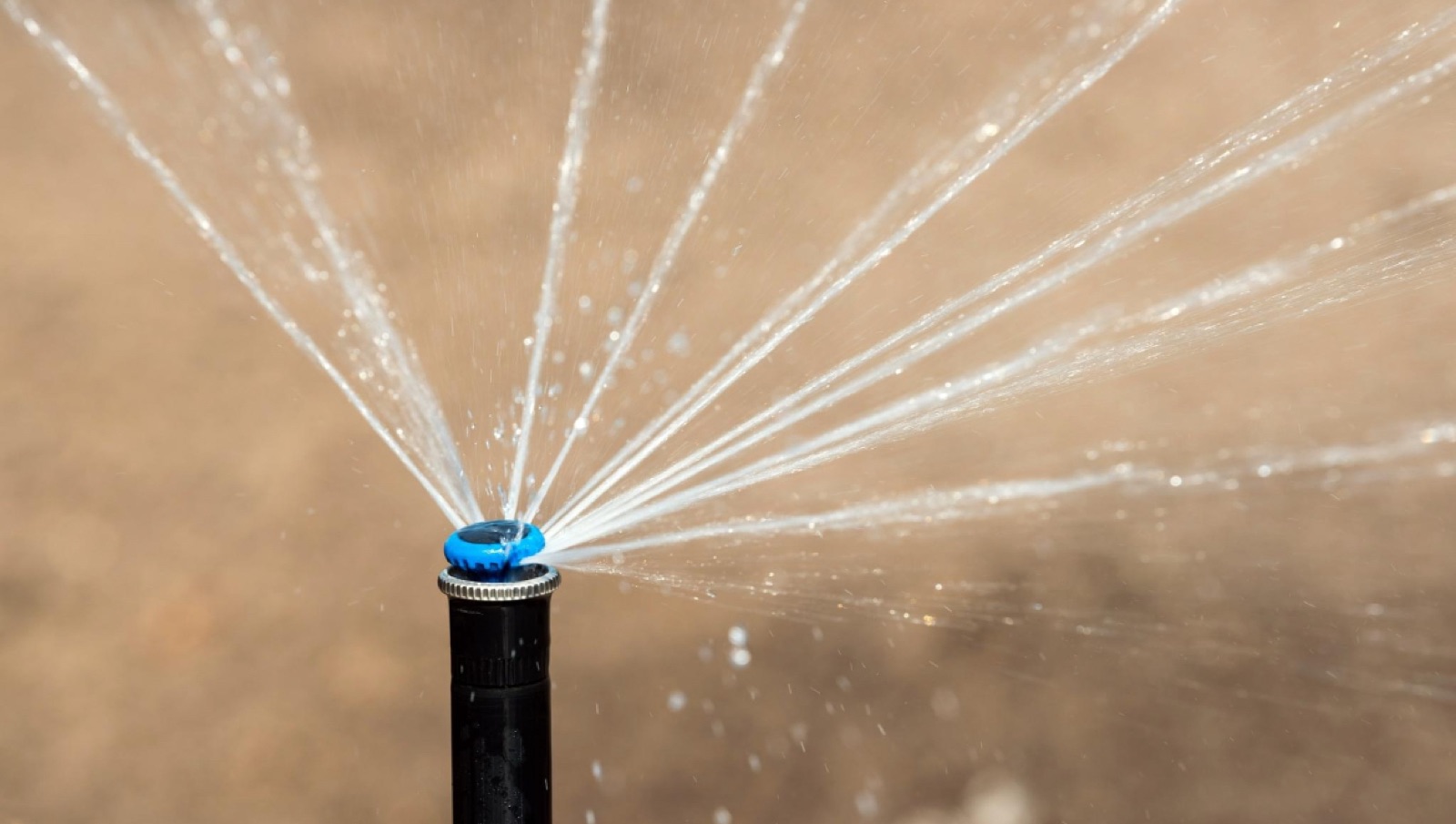
First, nozzles clog. Every time a rotor or pop-up spray head closes, a thin film of water evaporates inside the nozzle. The minerals don't evaporate — they plate out. Over months, that film turns into a ring of calcium scale that narrows the orifice. Spray patterns tighten, water throws shorter, and the zones that should overlap by a few feet stop overlapping. You'll see brown streaks between heads before you see a single one visibly broken.
Second, valve diaphragms calcify. Every irrigation valve has a rubber diaphragm that opens and closes the zone. Hard water leaves deposits on the sealing surface. Eventually the valve either won't fully close (zone runs when it shouldn't) or won't fully open (zone runs at half pressure). Most homeowners notice the second — "one side of the yard is always dry" — long before they figure out the diaphragm is the cause.
Third, drip emitters and micro-sprays choke. If you've got drip lines for a bed or a vegetable patch, the tiny emitters are the first thing to fail. Their orifices are already under 1 mm wide — it doesn't take much scale to shut them down entirely.
Fourth, pumps and backflow preventers take longer to fail but fail worse. Scale on a backflow device will eventually stick a check-valve open, which in the wrong conditions can mean non-potable water siphoning back into your drinking line. That's why Texas requires a backflow inspection on new installs and why our irrigation crews recommend annual backflow service, not just sprinkler tune-ups.
The cost of ignoring it
On a typical Lubbock residential system — 6 to 10 zones, 40 to 70 heads, plus a drip bed or two — the damage compounds slowly. You'll replace a couple of clogged nozzles the first year and shrug it off. By year three, half the heads are throwing short and a valve or two is sticking. By year five, you're looking at partial system replacement: heads, diaphragms, maybe a valve manifold rebuild, sometimes a backflow device swap.
We won't print specific repair numbers here because every yard is different — size, age of components, brand mix, access to the valve boxes. But the pattern is consistent: early, small repairs are a few hundred dollars. Deferred repairs on a neglected system can run into the low thousands once you're also re-grading areas that got over-dry-stressed and patching turf. The cheap move is catching it early.
How to slow it down (what actually works)
Most of what you read online about "fixing hard water" means installing a whole-house softener. That solves it inside the house, but most outdoor hose bibs bypass the softener — and irrigation systems run off a separate main feed entirely. Softening the irrigation line is expensive and usually not worth it on residential systems.
What does work:
1. Flush zones annually. At the start of each season, run each zone briefly with the end caps pulled on the most distant heads. The first minute of water flushes out scale fragments before they lodge in a nozzle. Our maintenance crew does this as a standard spring startup step.
2. Replace nozzles on a rotation. Don't wait for one to fail — plan to cycle through replacement every 3-5 years on high-use zones. New nozzles are cheap; water wasted on a 20-foot throw from a head spec'd for 30 feet is not.
3. Keep the filter clean. Most systems have a small mesh filter at each valve. Most homeowners have never seen theirs. Pulling and rinsing them annually prevents the slow pressure loss that puts stress on everything downstream.
4. Check the backflow device yearly. Not optional — it's a code requirement, and it's where scale damage can cause a public health issue, not just a dry lawn.
5. Match run times to the season. Over-watering is the fastest way to put extra cycles on every component. If your controller is still running April schedules in June, you're paying to wear out your own system. A smart controller pays for itself on component life alone, independent of the water savings.
When to call the crew
DIY handles nozzle swaps and filter cleaning. Past that, you're into valve diaphragm work, zone troubleshooting, controller diagnostics, and backflow testing — areas where "fix it wrong" costs more than "call a pro first."
The test we use: if you've replaced a head twice and it's still under-performing, or if more than one zone is running weak, it's a system-level issue and it's worth getting eyes on it. That's what a proper irrigation service visit is — diagnostic first, then a plan, then the work. Not a sales pitch.
Lubbock water isn't going to get softer. The Ogallala isn't changing, and the CRMWA blend isn't either. But a system that gets flushed, filtered, and tuned on schedule will outlast a neglected one by years — and cost you a fraction over its life.