Why most Texas plant advice doesn't work here
Three things make Lubbock different from the "Texas" most plant guides imagine:
The first is the soil. Our native soil is heavy clay over caliche, with a pH of 7.8 to 8.5 — decidedly alkaline. Plants that evolved in the acidic, humus-rich soils of East Texas (and anywhere east of I-35, really) spend their lives fighting chlorosis — iron deficiency driven by high pH — and either decline slowly or fail outright. That's why azaleas, hydrangeas, camellias, gardenias, and most rhododendrons don't make it here regardless of how well you water them.
The second is the climate. Lubbock averages about 18 inches of rain per year, most of it compressed into a few thunderstorm events in May-June and September — and the swing is enormous, from 8.73 inches in 1917 to 40.55 in 1941. Humidity is low, UV is intense, and wind is constant. Plants that evolved in humid subtropical climates (Southeast Texas, Gulf Coast) transpire at rates their root systems can't sustain here. By July, their leaves scorch on the edges and their growing tips die back.
The third is winter. USDA 7b puts our average coldest night around 5°F to 10°F — and a hard winter goes well below that. Most of the "drought-tolerant" plants marketed for Texas landscapes are rated for USDA 8 or 9 — they'd survive a Lubbock drought but not a Lubbock freeze. The combination — alkaline, low-water, hot summer, cold winter — is a specific ecological niche, and only a specific set of plants occupy it well.
The best plants for West Texas: the six we recommend to almost every customer
After a decade of landscape installs across West Texas, this is the short list we come back to for structure, color, and reliability:
**1. Texas Sage (Leucophyllum frutescens).** The single most forgiving shrub for Lubbock. Silver-green foliage year-round, purple bloom flushes every time humidity rises — so heavily after our July storm runs that it looks like it's been planted twice. Tolerates heat, drought, alkaline soil, and cold down to USDA 8a reliably (Zone 7b/8a boundary behavior in our area). Keeps a neat 4-6 foot form without much shaping. Lives essentially forever if you don't overwater it.
**2. Red Yucca (Hesperaloe parviflora).** Not actually a yucca — it's in the agave family — but the name stuck. Tall flower spikes every spring through fall, coral-red or yellow depending on cultivar, 3-4 feet tall at maturity, evergreen foliage, and hardy to -10°F. The hummingbirds find it before the blooms fully open. Thrives on neglect; fails if overwatered.
**3. Flame Acanthus (Anisacanthus quadrifidus var. wrightii).** Deciduous in Lubbock winters but comes back strong with orange-red tubular flowers from summer through first frost. Medium-sized (3-5 feet). Another hummingbird magnet, and one of the few reliable Lubbock plants that blooms continuously through our hottest months.
**4. Cedar Elm (Ulmus crassifolia).** Native to most of Texas including the South Plains, tolerates alkaline soil, moderate drought, and urban conditions. Grows to 50-70 feet but slower than silver maple or Bradford pear — an honest 30-50 year tree, not a 10-year tree. Beautiful yellow fall color. If you're planting a shade tree for your grandkids, this is the one.
**5. Texas Mountain Laurel (Sophora secundiflora).** Evergreen, purple wisteria-like blooms in early spring, tolerates heat and poor soil, and smells like grape Kool-Aid when in flower. Slow-growing (8-15 feet over many years), so it won't block a window fast, but it's one of the few evergreen flowering trees that handles Lubbock alkaline + drought + cold. The seeds are toxic — not a concern for adults, worth knowing if you've got young kids or pets who eat things.
**6. Honey Mesquite (Prosopis glandulosa).** Not for every yard. But if you have an acre, a back corner, or a ranch-style property, mesquite is the native canopy tree of the Llano Estacado. Drought-proof in a way nothing else is, filtered shade that lets turf grow under it, beautiful gnarled form with age, and nitrogen-fixing roots that actually improve the soil around it. Thorns are the tradeoff. Not a front-yard lawn tree — a back-yard character tree.
For perennials and groundcovers we lean on **Autumn Sage (Salvia greggii)**, **Blackfoot Daisy (Melampodium leucanthum)**, **Damianita (Chrysactinia mexicana)**, and **Mexican Feathergrass (Nassella tenuissima)** — all low-water, alkaline-tolerant, and proven in our landscape maintenance rotations.
What to avoid (and what to plant instead)
The heartbreak list — beautiful plants that fail in Lubbock, with the alternative that works:
- **Bradford Pear** (short-lived, splits in ice storms, invasive) → **Cedar Elm** or **Chinquapin Oak** - **Silver Maple** (weak wood, shallow roots, chlorotic in our soil) → **Cedar Elm** or **Pecan** (if you have water and space) - **Azaleas / Hydrangeas** (need acidic soil, die in our pH) → **Texas Sage** for flowering shrub, **Autumn Sage** for flowering perennial - **Crepe Myrtle** (works in Lubbock but attracts bark scale and has been struggling the last three seasons) → **Flame Acanthus** or **Vitex (Chaste Tree)** as alternative summer bloomer - **Photinia (Red Tip)** (entomosporium leaf spot in Lubbock humidity) → **Texas Sage** or **Wax Myrtle** - **Boxwoods** (fail in alkaline soil, look rough by year 3) → **Dwarf Yaupon Holly** or **Germander** - **Asian Jasmine** (freezes back every 3-4 years) → **Trailing Lantana** (dies back but returns reliably) or **Damianita** for evergreen - **Rose of Sharon (Althea)** (OK performer but not great) → **Desert Willow (Chilopsis linearis)** for similar effect with superior drought performance
The most common failure we see: homeowners install a beautiful front-bed design that looks like East Texas or Austin, struggle with it for 3 years, and eventually tear it out. We'd rather sit with you at the design stage and build something that thrives on its third year rather than limps to it.
Soil prep that actually helps
The conventional advice — "work in 3-4 inches of compost and peat moss" — is bad advice for xeriscape-style planting in Lubbock. Native and adapted drought-tolerant plants evolved in mineral soil; too much organic matter creates a moisture-retentive pocket that roots don't want to leave, and the plant never develops the deep root system it needs to survive a Lubbock summer.
What we actually do on xeriscape installs:
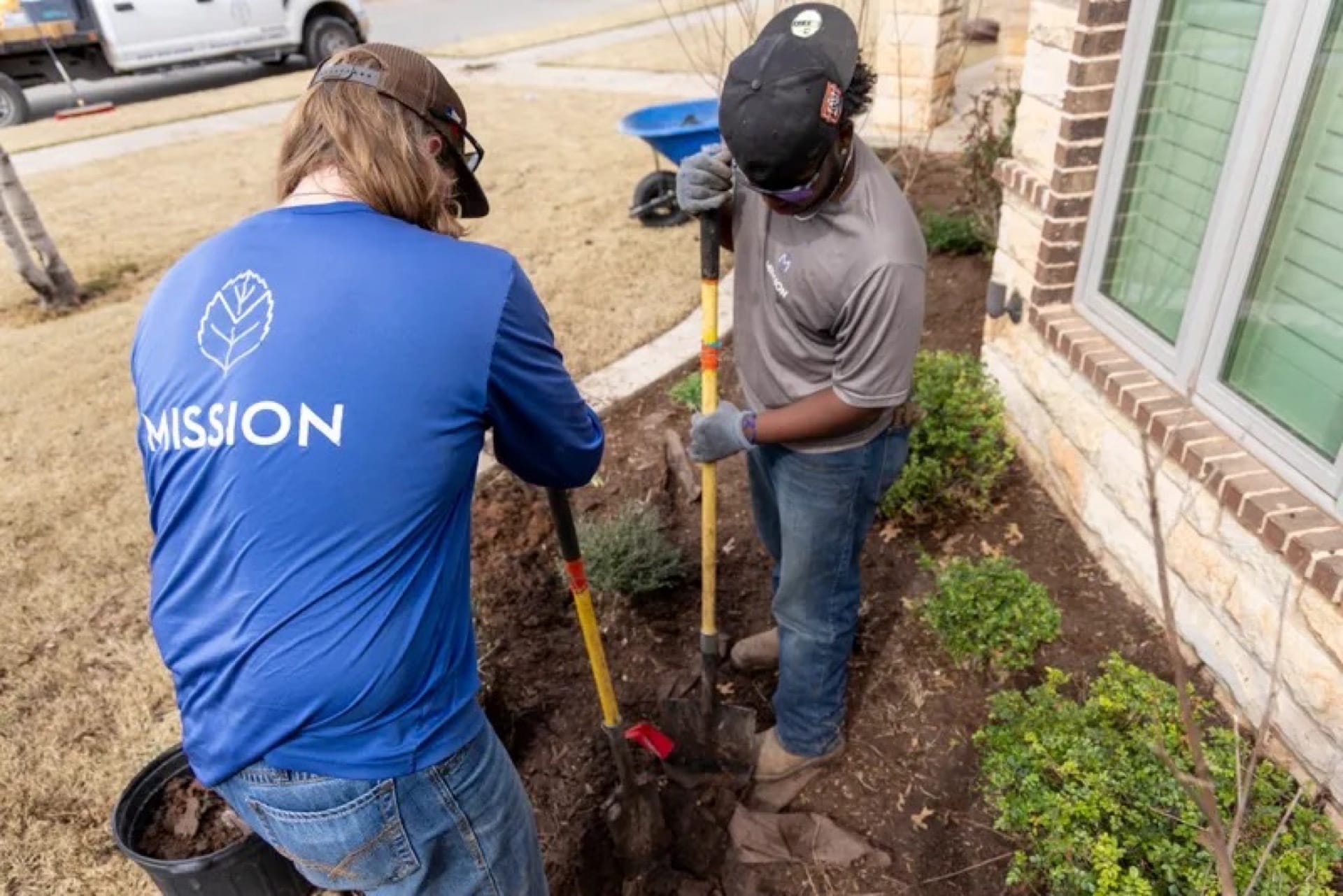
- **Break the caliche layer** if present. If your spade bounces 8 inches down, you've got caliche. Breaking it (hydraulically on larger jobs) gives roots a path down instead of out. - **Mix organic matter to 10% by volume max**, to a depth of 12+ inches. This prevents a perched water table that rots roots. - **Use inorganic mulch** (decomposed granite, pea gravel, local stone) for true xeriscape beds. Organic mulch breaks down into compost and defeats the above. - **For conventional landscape beds** (mixed plantings, annuals, lawn transition), use 3-4 inches of hardwood mulch — but keep it 2-3 inches away from plant stems to prevent collar rot.
Never mulch volcanoes around trees. You see them everywhere in Lubbock commercial installs. They kill the tree by trapping moisture against the bark. Donut, not volcano.
When to plant
**Fall is better than spring in Lubbock** for most trees and shrubs. October through early December lets roots establish through the cool wet months (relatively speaking) before the summer stress test. Plants installed in spring have to handle their first Lubbock summer with a root system that's had 60-90 days to develop. Fall-planted specimens go into their first summer with 5-6 months of root growth behind them. Survival rates are noticeably higher.
That said, spring works — April through mid-May for most of the list above, avoiding planting during a frost risk window (Lubbock's average last freeze is April 10, with 90% no-frost confidence by April 23). Cedar Elm and Mountain Laurel go in best at container size in early spring or late fall. Everything else is flexible but leans fall.
Perennials and groundcovers are seasonal — Autumn Sage, Blackfoot Daisy, and Damianita all prefer spring installation so they have a full growing season to root before winter.
How we actually help
This post is a starting map, not a substitute for a walk-through. Every Lubbock yard is different — sun exposure, existing tree canopy, soil depth to caliche, existing irrigation layout, what the previous owner tried to plant that's now half-dead. A 30-minute walk-through tells us more than any post can.
If you'd rather have us design, source, and install it — that's the core of our landscape maintenance and install work. We also handle bed redesigns (tearing out what's failing and replanting with what works), integration with irrigation systems, and the hardscape and outdoor construction that often comes with a rework — raised beds, decorative stone, permeable paths, accent boulders.
The goal with any Lubbock landscape is the same: something that looks as good in year five as it does in year one, without costing you the water budget of a rice paddy. The plant list above is the 80% that gets you there.